
ABOUT
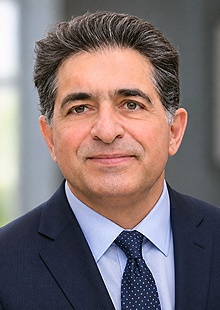
Dr. Hamid Garmestani is a Professor in the School of Materials Science and Engineering at the Georgia Institute of Technology. He received his education from Cornell University (Ph.D. 1989 in Theoretical and Applied Mechanics) and the University of Florida (B.S. 1982 in Mechanical Engineering, M.S. 1984 in Materials Science and Engineering). After serving a year as a post -doctoral fellow at Yale University, he joined the Mechanical Engineering Department at Florida State University (FAMU-FSU College of Engineering) in 1990.
Primary research and teaching interests include microstructure/property relationship in textured polycrystalline materials, composites, superplastic, magnetic and thin film layered structures. He uses phenomenological and statistical mechanics models in a computational framework to investigate microstructure and texture (micro-texture) evolution during processing and predict effective properties (mechanical, transport and magnetic). His present research interests are processing of fuel cell materials and modeling of their transport and mechanical properties.
Dr. Garmestani has been the recipient of a research award (FAR) through NASA in 1997. He received the Superstar in Research award in 1999 by FSU-CRC. He has also been the recipient of the Engineering Research Award at the FAMU-FSU College of Engineering, Spring 2000. He is a member of the editorial board of the International Journal of Plasticity and board of reviewers for journal of Metal Transaction. He is presently funded through NSF (MRD), NASA, Air Force and the Army.
Teaching Interests
Professor Garmestani’s teaching focuses on materials science and engineering fundamentals at both undergraduate and graduate levels. His courses emphasize structure-property relationships, materials processing, and computational materials science. He aims to integrate experimental and theoretical approaches, fostering critical thinking and problem-solving skills among students. His instruction involves a combination of lectures, discussions, and hands-on experiences to prepare students for research and professional practice in materials science and engineering. (69 words)
PUBLICATIONS & PATENTS
- SF Nabavi, H Garmestani, A comprehensive review on recent organ additive manufacturing process: Materials, process, functional matter, structural matter, living matter, Journal of Manufacturing Processes 158, 148-184, 2026
- SF Nabavi, H Garmestani, Multi-scale modeling of metallurgical phenomena in metal laser powder bed fusion additive manufacturing: A comprehensive review, Journal of Manufacturing Processes 150, 610-644, 2025
- N Nasajpour-Esfahani, PB Patel, H Garmestani, SY Liang, Introduction to Photocatalysis and Its Significance in Green Energy Applications, Green Nanostructured Photocatalysts for Clean Energy, 3-26, 2025
- W Huang, R Gao, H Garmestani, SY Liang, Physics-based analytical modeling of materials properties in metal additive manufacturing, Journal of Manufacturing Processes 153, 680-692, 2025
- SF Nabavi, H Garmestani, F Fekri, AI-powered language models for alloy design and laser-based manufacturing: A review of NLP applications in materials science, Journal of Manufacturing Processes 156, 86-120, 2025
- Li DS, Saheli G, Khaleel M, Garmestani, H., “Microstructure optimization in fuel cell electrodes using materials design”, CMC-COMPUTERS MATERIALS & CONTINUA 4 (1): 31-42 AUG 2006.
- D.S. Li, H. Garmestani, S. Ahzi, Processing path optimization to achieve desired texture in polycrystalline materials, Acta Materialia 55 (2007) 647–654.
- H. Garmestani, S. Lin, B. Adams, S. Ahzi, "Statistical Continuum Theory for Texture Evolution of Polycrystals", Journal of the Mechanics and physics of Solids 49, (2001) 589-607.
EDUCATION & AWARDS
- Ph.D. Theoretical and Applied Mechanics, Cornell University, 1989
- M.S. Materials Science and Engineering, University of Florida, 1984
- B.S Mechanical Engineering, University of Florida, 1981
RESEARCH INTERESTS
Professor Garmestani’s research centers on multiscale modeling and characterization of structural materials. He investigates the microstructure-property relationships using computational and experimental techniques, aiming to predict material behavior under various conditions. His work includes developing mathematical models and applying multiscale simulation methods to understand materials’ structural evolution and performance. The research actively involves interdisciplinary approaches to address complex challenges in materials science. Presently, his research involves additive manufacturing in metallic alloys and bio-implants.
- Mechanical properties
- Statistical approaches
- Microstructure Sensitive Design