
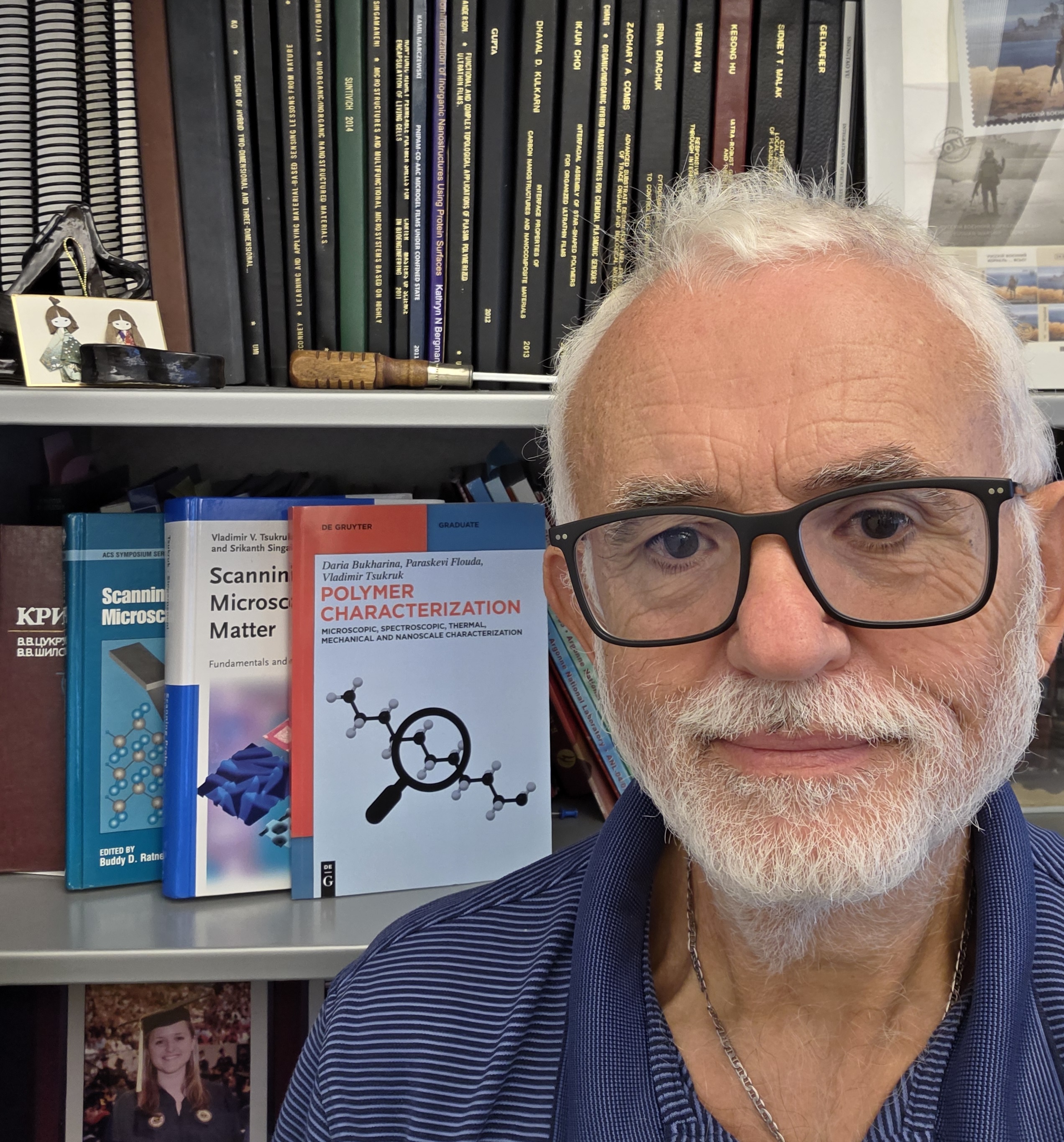
For years, School of Materials Science and Engineering (MSE) Professor Vladimir Tsukruk has taught graduate students not only the theory behind polymer characterization but also the practical skills needed to conduct experiments, collect data, and interpret results, emphasizing real-world implications. Now, he has translated that experience into a new textbook, Polymer Characterization: Microscopic, Spectroscopic, Thermal, Mechanical and Nanoscale Characterization, co-authored with former students Dasha Bukharina and Paraskevi Flouda.
The book grew out of Tsukruk's graduate course on polymer characterization, which combines classroom instruction with extensive laboratory experience. Students learn how to use a wide range of techniques, including spectroscopy, microscopy, X-ray diffraction, mechanical testing, and thermal analysis, to study polymer materials and composites. "Teaching this class for many years helped students acquire not only the fundamentals of major experimental techniques but also valuable practical experience in observing real experimental routines and analyzing collected data," Tsukruk said.
Recognizing the value of those hands-on lessons, Tsukruk and his co-authors developed a textbook that goes beyond traditional theory. QR codes embedded throughout the book link readers to videos filmed in Georgia Tech's Materials Characterization and Analysis Center (MCAC), allowing students to watch real laboratory demonstrations, sample preparation procedures, data collection workflows, and analysis techniques.
.png)
The book was designed primarily for first-year graduate students entering materials science programs from a variety of academic backgrounds, including chemistry, physics, and engineering. An introductory section reviews polymer fundamentals before guiding readers through common characterization methods used in both academic and industrial research. A key goal was to address topics often overlooked in traditional textbooks, particularly the practical challenges that researchers encounter when performing experiments. "Most current polymer characterization texts are solely theoretical books," Tsukruk said. "There is little discussion of experimental know-how, instrument limitations, artifacts, choosing the right conditions, or even the time and cost of conducting experiments."
To help bridge that gap, the book highlights common experimental pitfalls while demonstrating how researchers can recognize and avoid them. One example is atomic force microscopy, where imaging artifacts can lead to misleading conclusions if not properly understood. The emphasis on real-world experimentation reflects Tsukruk's broader teaching philosophy. Throughout his courses, students work with experimental datasets from actual materials and learn to evaluate results while considering factors such as sample preparation, measurement sensitivity, resolution limits, and data quality.
According to Tsukruk, one of the most challenging lessons for students is understanding that theoretical predictions and experimental outcomes do not always align. "Theory and experiments are different," he said. "Theoretical equations and models can be valid, but the complexity of real polymer materials often produces outcomes that must be considered carefully in practical applications."
Ultimately, Tsukruk hopes the textbook helps students develop a more realistic understanding of materials characterization and prepares them to become more effective researchers. "Practical characterization is an important aspect of materials research," he said. "Many real-life factors and instrumental limitations must be taken into account to correctly understand materials properties."
By combining foundational concepts with laboratory demonstrations and practical guidance, Polymer Characterization: Microscopic, Spectroscopic, Thermal, Mechanical and Nanoscale Characterization provides students with a resource that connects classroom learning to the realities of experimental materials science.