
Georgia Tech is a core founding partner on a new 10-year Department of War initiative aimed at modernizing textile manufacturing in the United States to support the defense industry.
FutureTEX – which includes $36 million in its first year and has a ceiling of $480 million over a decade – brings together university, industry, government, and nonprofit partners to advance textile manufacturing technologies for military and domestic applications. FutureTEX will champion workforce development and modernization of facilities and equipment to increase U.S. competitiveness.
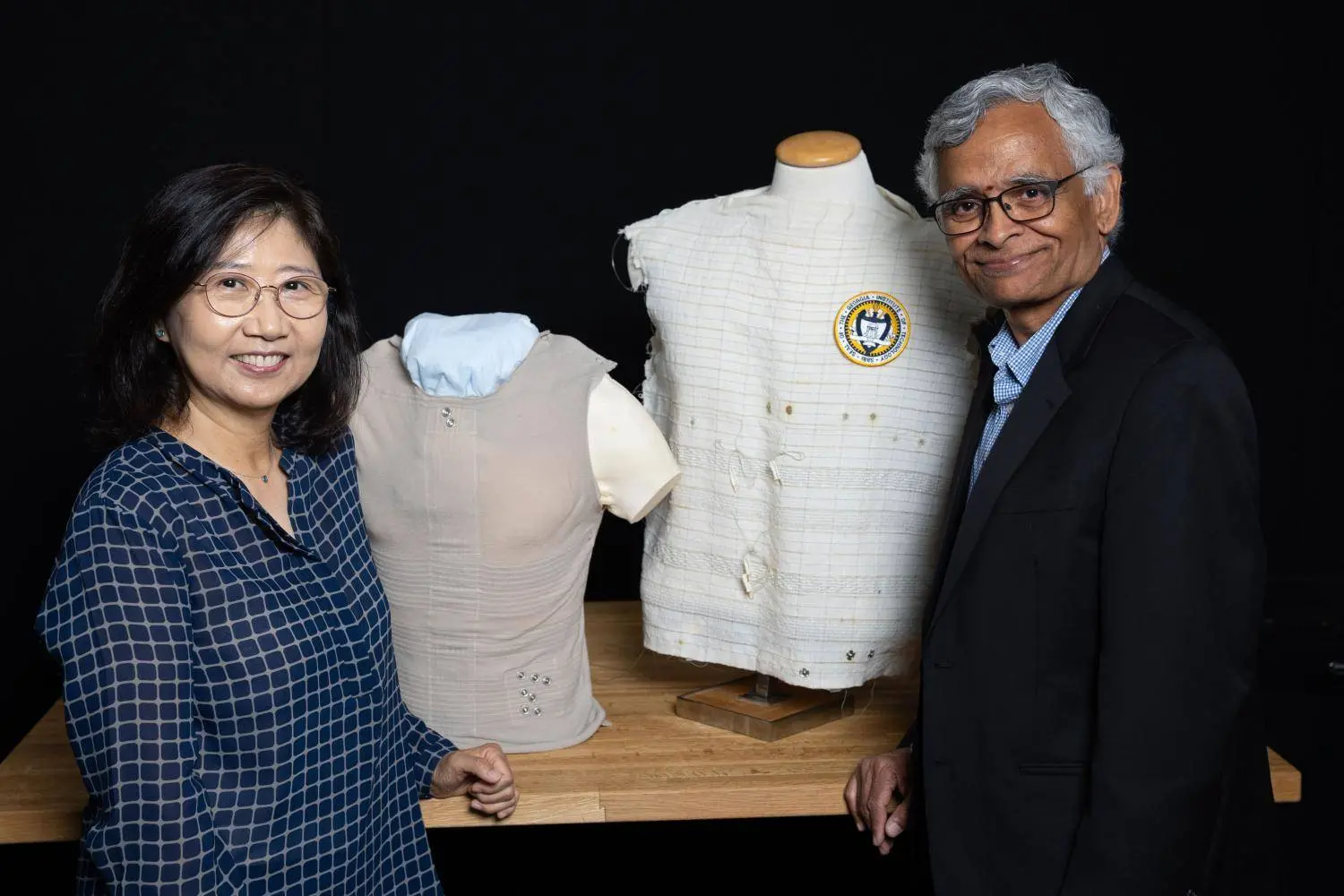
School of Materials Science and Engineering (MSE) researchers Sundaresan Jayaraman and Sungmee Park will lead Georgia Tech’s efforts. They will work with American manufacturing companies to capitalize on digital infrastructure and other emerging technologies to make the domestic supply network more robust.
“FutureTEX exemplifies Georgia Tech’s commitment to drive research that advances national security, economic resilience, and workforce development,” said Tim Lieuwen, executive vice president for Research. “Georgia Tech is proud to serve as a founding partner in this initiative, applying our deep interdisciplinary expertise to build a tech-driven, resilient supply network that serves and protects our soldiers and strengthens our economy.”
North Carolina State University will lead the overall FutureTEX initiative. Other core partners include Drexel University, Gaston College, University of Massachusetts Lowell, and the nonprofit Industrial Sewing and Innovation Center.
Campus-Wide Expertise
Jayaraman came to Georgia Tech in 1985 when nearly 70% of the clothing Americans bought was made in the U.S. That’s dropped to 3% because of globalization, trade policies, and cheaper overseas labor. Still, federal law requires all military clothing and textiles to be produced domestically.
To Jayaraman, the 40-year downward slide is about much more than where T-shirts or socks are manufactured.
“It’s a matter of national security, economic resilience, and workforce development,” said Jayaraman, a professor in MSE. “A pair of jeans may seem insignificant in the big picture. But creating durable, reliable pants requires specialized skills and manufacturing expertise. If those skills disappear, the nation risks losing its ability to quickly produce critical equipment for soldiers.”
Much of Jayaraman’s early Georgia Tech work for the Pentagon centered on laying the foundation for a resilient and agile defense apparel supply chain. He also studied how digitization and enterprise modeling could make manufacturing more efficient and explored the use of artificial intelligence to help the military’s procurement process.
With MSE as the hub, Jayaraman and Park will harness expertise across Georgia Tech for FutureTEX. They are establishing partnerships across campus to participate in the national initiative, including other Colleges and Schools, the Georgia Tech Manufacturing Institute, the Supply Chain and Logistics Institute, and the Institute for Robotics and Intelligent Machines.
“Georgia Tech is uniquely positioned to support FutureTEX and our nation because of the breadth of our focus areas,” said Park, an MSE principal research scientist. “We have deep engineering expertise in smart textiles, advanced materials, automation, and manufacturing. The Institute also leads in public policy and business.”
Georgia Tech and the FutureTEX partners will work with manufacturers, industry associations, workforce organizations, and government partners to better understand their needs and priorities. The team also will assess suppliers based on their capabilities and automation levels to create an inventory of manufacturers and their strengths. The insight will help government agencies quickly identify which companies can produce critical materials during emergencies or periods of increased demand to ensure military readiness.
“Our success will come from balancing near-term results with a long-term vision,” Park said. “Early FutureTEX projects can demonstrate the value of advanced textile manufacturing and attract additional industry engagement. Longer-term initiatives can reshape the nation’s manufacturing landscape. FutureTEX isn’t looking to recreate America’s labor-intensive factories of the past. Instead, we want to build a modern, technology-driven manufacturing ecosystem.”
Park and Jayaraman stressed that FutureTEX goes beyond clothing. Textiles are used in carpets, composites for drones, parachutes, and many other military essentials. Jayaraman said FutureTEX also is about ensuring the United States has the technology, workforce, and manufacturing capabilities to support its economy and protect citizens.
“FutureTEX can help rebuild a critical sector and create a stronger, more resilient future for American manufacturing,” Jayaraman said. “Bringing manufacturing and advanced technology back to our country will allow us to train more workers, strengthen domestic supply chains, and ensure the United States remains globally competitive for generations to come.”