
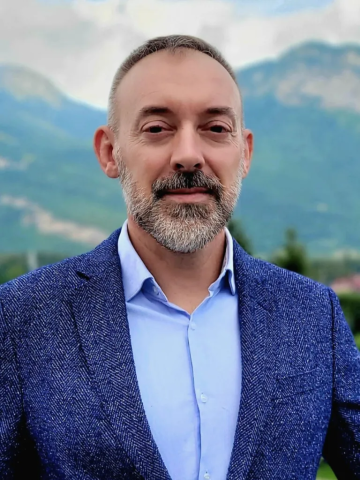
photo credit: The Royal Society of Chemistry
When Renaud Demadrille talks about his work, his enthusiasm for discovery is unmistakable. A chemist by training and now a research director at CEA‑Irig in Grenoble, France, Demadrille has spent two decades developing materials that could change the future of energy technology. This year, he brought that expertise to Georgia Tech as a Fulbright Scholar, collaborating with the School of Materials Science and Engineering (MSE) to design innovative materials for optoelectronics and sustainable energy applications. His path to becoming a leading researcher wasn’t straightforward. He once imagined a life in law, but a growing passion for science and lifelong learning ultimately shaped a career defined by curiosity, collaboration, and global impact.
The Fulbright Scholar Program: Building Bridges Through Research
The Fulbright Program is one of the world’s most recognized platforms for international academic exchange, and Demadrille quickly discovered how deeply it resonates in the United States. “For many people in the U.S., this is a mark of excellence,” Demadrille said. While he knew of the program’s prestige before applying, he was struck by how widely the Fulbright name opens doors and connects scholars across disciplines.
Demadrille’s decision to apply grew naturally from a long‑standing relationship with MSE Chair and Professor Natalie Stingelin. The two first met years earlier while she was working in Europe. Their collaboration accelerated after Demadrille hosted one of her students at CEA‑Irig, and the pair began discussing opportunities for deeper partnership. That opportunity arrived in late 2024, when the Fulbright Commission issued a call for research proposals. With Stingelin’s support, Demadrille submitted a project that would allow him to spend several months embedded in Georgia Tech’s research community.
Pioneering Sustainable Materials for Optoelectronics and Energy Conversion
At his core, Demadrille is a chemist driven by the desire to learn something new every day. His research focuses on designing organic materials based on abundant elements, which are materials that could replace expensive, mined inorganic semiconductors currently used in technologies like solar cells and LEDs.
His journey into optoelectronics began unexpectedly. After earning his PhD studying photochromic dyes for optical lenses, he moved into industry, working on polymers for sealing applications. Everything changed when he joined the French Alternative Energies and Atomic Energy Commission (CEA) as a postdoctoral researcher. There, he encountered the world of organic semiconductors under the mentorship of Professor Adam Pron, a former student and collaborator of Nobel Prize laureates Professors Alan MacDiarmid and Alan Heeger. “This completely changed my trajectory,” Demadrille recalled. “I started to be very interested in polymers for optoelectronics, a field where chemistry, engineering, and physics all progress together.”
Optoelectronics is defined as a branch of electronics that deals with electronic devices for emitting, modulating, transmitting, and sensing light. Currently at CEA‑Irig, Demadrille’s team works across a broad landscape of sustainable energy materials:
Photovoltaics – converting sunlight directly into electricity
Thermoelectric materials – turning heat gradients into usable power
Solar fuels – harvesting sunlight to produce hydrogen or drive CO₂‑reducing reaction
These technologies share a common goal: creating affordable, sustainable energy solutions accessible worldwide. “We develop materials that are less expensive, based on abundant elements,” Demadrille explained. “We want these technologies to be sustainable and available to everyone.”
Demadrille’s work spans the full pipeline—from molecular design and synthesis to device testing and understanding how a material’s structure dictates its properties. That balance of fundamental discovery and real‑world application is what makes the field so exciting to him.
A Research Environment Defined by Collaboration
During his time at MSE, Demadrille has observed meaningful differences between research cultures in France and the United States. Despite these differences, he emphasizes that interdisciplinary collaboration is essential everywhere, especially in energy research. “Without an interdisciplinary approach, you only access a fraction of the problem,” Demadrille said. Bringing together chemists, physicists, engineers, and material scientists allows researchers to understand not only how materials behave, but how to improve them.
For younger scientists, Demadrille stresses one lesson he wishes he had learned sooner: build your professional network early. As a student, he often watched collaborations happen around him rather than being involved directly. Now, he encourages his students to engage in networking from the outset—to connect with peers, seek out collaborations, and participate in international exchanges like the Fulbright.
Looking Ahead
Despite growing administrative challenges and a rapidly changing global research landscape, Demadrille remains optimistic. Scientists, Demadrille says, are inherently resilient and committed to long‑term goals that transcend short‑term obstacles. “We have to think globally. We are developing materials for energy that are useful for everyone,” Demadrille said. “We have to continue.”
His Fulbright experience has strengthened his connections, expanded his collaborations, and deepened his commitment to building bridges between the U.S. and Europe, and at Georgia Tech, he continues doing what he loves most: exploring new materials, pursuing discovery, and learning something new every day.