
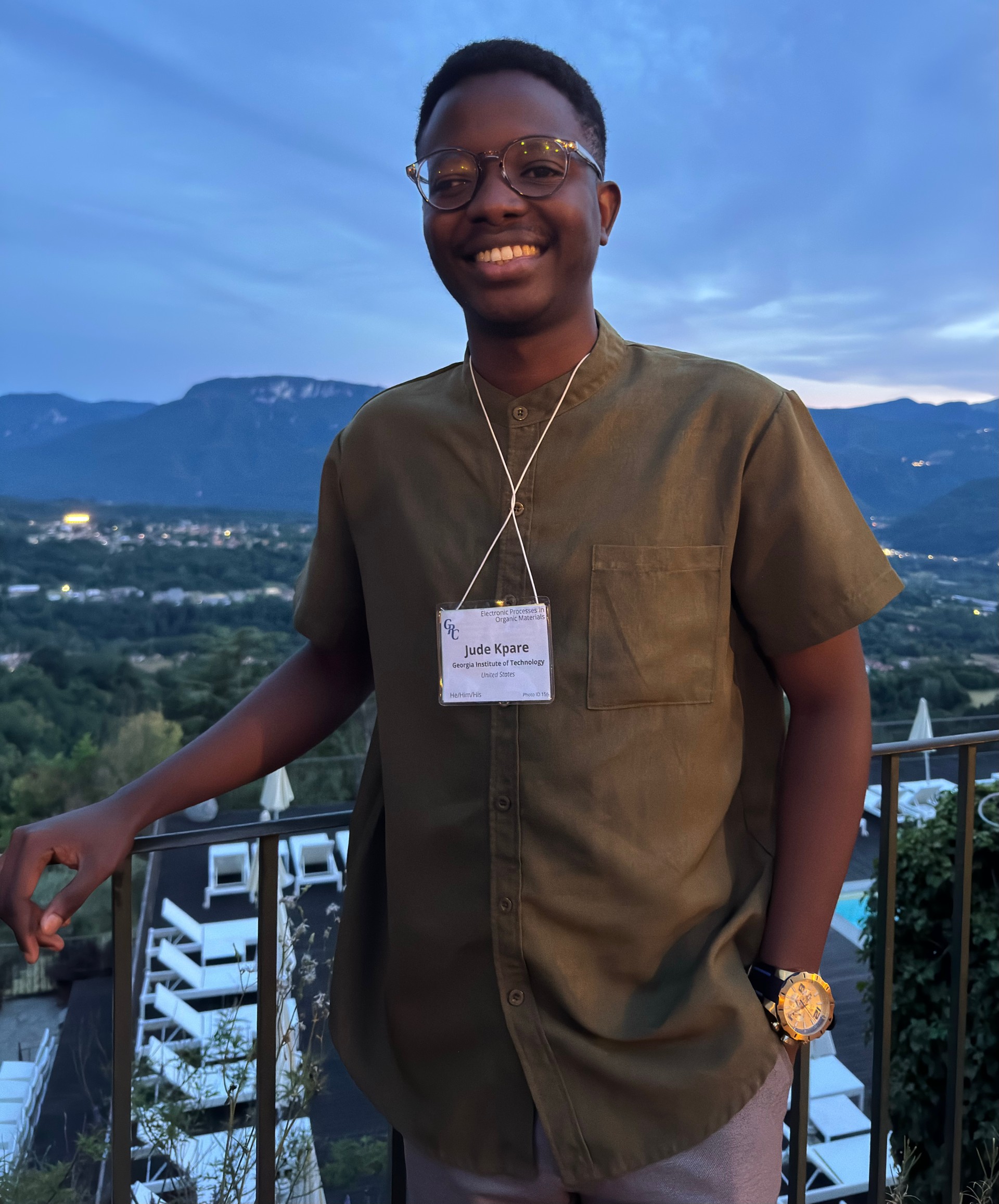
The Electronic Processes in Organic Materials Gordon Research Conference (GRC) is a premier international meeting that brings together researchers from around the world to discuss cutting-edge advances in organic and hybrid electronics. The five-day conference emphasizes unpublished research, in-depth scientific discussion, and collaboration, with this year’s program focusing on the future of organic and hybrid electronic materials and devices, including the use of advanced characterization tools, lab automation, and artificial intelligence to accelerate discovery.
This year, the School of Materials Science and Engineering (MSE) graduate student Jude Kpare presented his poster titled Phase Morphology as a Lens to Rationalize Electrochemical Doping Behavior in Organic Semiconductors, for which he earned the Best Poster Award at the GRC. Winning this award at arguably the most prestigious conference in organic electronics is no small feat. "It rewards the hard work I have put in over the past 2 years on this project and reaffirms the quality of work we’re doing in the [MSE Chair, Natalie] Stingelin and [MSE professor, Erin] Ratcliff Labs," said Kpare. "It also gives me the confidence and motivation to work even harder to move this project and other related projects forward for the benefit of our world."
Kpare's research focuses on creating design rules that link phase morphology – how the chemically and structurally distinct regions of a material system are arranged and connected – to electrochemical doping processes in organic semiconductors. This research is important because most emerging applications of organic semiconductors, including bioelectronics, batteries, and photoelectrochemical cells for solar energy conversion & storage, involve electrochemical doping, yet very little is understood about how phase morphology affects these key processes and, ultimately, device performance. Kpare's research bridges this gap.
Organic semiconductors are lightweight, flexible, and can be printed relatively cheaply over large areas. They are essentially plastics that conduct electricity, making them promising for technologies such as wearable health sensors that read signals from the body, better batteries, and devices that turn sunlight and water into clean fuels. "For any of these devices to work, the material must repeatedly soak up and release electrical charge, and how well it does that depends on how its components are arranged inside," Kpare said. "My research figures out which arrangements work best and why, turning trial-and-error into a recipe book engineers can use to build devices that perform better and last longer—bringing us closer to affordable health monitors, longer-lasting energy storage, and clean fuels to power our world, especially in this age of artificial intelligence."
Throughout the duration of the GRC, the conversations Kparee engaged in with researchers whose papers he admired and peers who are shaping this field were the most valuable aspect of his time at the conference. GRCs are intentionally small and discussion-driven, so for a full week, he "got to talk science" over meals, at poster sessions, on bus rides, and on walks through Lucca, Italy, where the conference was held. "I left with honest feedback on my work, fresh ideas to bring back to the lab, and, most valuable of all, bonds with both established and upcoming scientists that I believe will last a lifetime," Kpare said.
Through the MSE courses, Kpare has had the opportunity to deepen his knowledge and expertise in materials science, the foundation of his research. Kpare credits MSE professor Alena Alamgir’s Advanced Presentation course for equipping him with effective presentation skills, which have been invaluable to his growth. Kpare has also used his time at the Materials Research Society (MRS) and Center for Organic Photonics and Electronics (COPE) poster competitions to hone his skillset. Ultimately, the collaborative nature of research at MSE played a critical role in Kpare's growth. He said, "having the opportunity to collaborate with top professors in diverse fields who bring their individual expertise to solve critical societal challenges is an opportunity I value greatly."